Showing posts with label Tech. Show all posts

Steve Jobs: Invention as the Mother of Neccessity.

FRIDAY, OCTOBER 7TH, 2011

With the passing of Apple CEO Steve Jobs, there will be much talk concerning his greatest contribution to the tech world. Was it the birth of the GUI (Graphical User Interface)? Plug 'n Play? The mouse? Unibody laptops? The iPhone? The iPod? Maybe it was re-inventing music retail? Or Apple Stores? Was it the introduction of the spreadsheet (Visicalc), or perhaps PDA computing (Newton/Touch)?

If we are to be honest, his true "legacy" product is none of the above.

No, the one product that Mr Jobs should be remembered for, in fact the ONLY product actually created by Steve Jobs (Steve Wozniac built the first Apple computers which were sold from his garage), is the Apple Consumer©.


Steve Jobs did not offer products that the world needed, he sold a lifestyle which in turn created a desire for the items he had to offer. This was facilitated by an unrivaled intuition into the consumer's pulse, allowing him to identify products which would resonate with consumers on a personal level. His brilliance was not only in the area of system design (although he had a 'Bang and Olufsen' sense of esthetics). What placed Mr Jobs so far above all other CEO's of his age, was his keen insight into the what drives the masses. He understood the correlation between price and perceived status, and that brand loyalty was created most effectively by marketing image-defining uniqueness (fashion?), while selling memberships to an exclusive insider "clique". (not an easy sell for a mass-market product.)

People don't buy iPhones because they're the best cellphones available (although they very well may be - that debate is beyond the scope of this post), they buy iPhones because they are "THE" phone to own. Macbooks aren't better because they're faster, sleeker or more advanced, they're better because they carry a vastly superior cool factor. That level of cool goes beyond the hardware itself, and approaches religious significance. In our self-centered "me-first" world, how can we possibly resist a range of products, who's very names proclaim "i" (humbly, in lower case!).

Steve is a product of "The Me Generation" and included a membership to "The In Crowd" with every Apple product sold. Macs are to computers what foie-gras is to chopped liver. While plain old chopped liver may be just as tasty, it's the consumer of the foie-gras who is superior for having such discerning tastes!

What makes this marketing feat even more outstanding, is that while the company is as blatantly capitalist as the rest of the industry, it is brilliantly presented as the every-man alternative to its evil corporate competitors.

"Computers for the rest of us" was Madison Avenue speak for "Elitism for the Masses", while "Think Different" was really "Apple users are superior people"

This outstanding (albeit manipulative) marketing, and the image it creates, not only for Apple, but for the Apple customer themselves, remains Mr Jobs' real claim to fame. He never 'invented' anything of note (while he may have "inspired" more than a few cool toys) or contributed to a better world (besides bringing us closer to a Tofler-esque "Third Wave"), but Steve Jobs did introduce a psychopathic-bond style of marketing to the mainstream, and made us all love being converted into brand-loyal zombies.


Don't get me wrong, Apple products are outstanding, and often feature bleeding-edge technology that the entire industry benefits from eventually, but is that why we want Apple products? Or do we want (need?) them simply because our self-image suffers if we are not among the faithful.

Steve Jobs most impressive accomplishment lies not with alternative technology solutions - it is instead in the re-purposing of computer hardware as a fashion accessory.

R.I.P. Mr Jobs. The last time Apple was without you, it floundered to near extinction. Without your near-Machiavellian marketing prowess, history will very likely repeat.

What will your legacy be then? Will you remain a household name? A "visionary"? A "genius"? Or will you fade to relative obscurity like Thomas J Watson and the others who came before you.

When all is said and done, you won't be leaving the world a better place for having been here. You achieved a position of unrivaled influence, and used it to create nothing but gadgets and personal wealth. Granted, that is hardly unusual among CEO's, but it certainly demonstrates that you do not deserve the accolades suggesting that you somehow transcended your corporate station. You didn't transcend it, you embodied it!

THAT is what should be mourned with your passing. It is also why I refuse to join the fanboys in your virtual deification.


Canadian Rights Trumped by Corporations

WEDNESDAY, FEBRUARY 9, 2011 


The CRTC

Canadian Radio-television and Telecommunications Commission


Mission Statement:
To ensure that Canadian communications contribute fairly and equitably to Canada's economic, social and cultural prosperity through regulation, supervision and public dialogue.

Vision Statement:
World-class quality communications, with a distinct Canadian presence, in the public interest.

 (oh, and Santa Claus and the Easter Bunny are REAL!!)  


Last month I got a call from my isp, advising me that as of March 1st, my unlimited internet account will be restricted to a maximum 25GB of bandwidth (or about one steam game - with no bandwidth left over to play it). Any additional bandwidth I might use will be billed at the cost of $2.95 per GB up to 60GB, and then $1.75 per GB for any use above that. No grandfathering, exceptions or higher bandwidth plans to chose from.

As the message continued I was advised that so far (at January 10th), I had  already used 70GB for the month. Simple calculations conclude that under the new plan, my $48/month (plus tax) unlimited internet service would now cost me $241  if my current usage levels were to continue.
 Ouch!

I'd like to add here, that Bell Canada charges my isp $4.25 for each 40GB block of bandwitdh. That's just fractionally over 10¢/GB  wholesale... but it's gonna cost consumers $1.50 or more retail???

Here Bell, why not take my left testicle too! Go ahead, take it in the name of cultural prosperity!

This is not a policy that my isp chose to implement - they rely on things like unlimited access plans and free premium usenet to compete with the big guys. No, they have been legislated to do so by that guardian of the  public interest, the CRTC.

You see, it seems that with the advent of Netflix and various other streaming services coming online in Canada, the big players (Bell, Rogers, Shaw, Telus) are at an unfair disadvantage. These billion-dollar companies can't afford to offer unlimited access to their subscribers (bandwidth can cost THEM as much as 3¢ a GB!), so why should smaller isps be allowed to do so. They can however, afford to offer on-demand TV and Movies plans - and charge absolutely no bandwidth fees (the service itself costs approx 24.95 a month).

The CRTC agreed, and instructed all Canadian isp's to introduce Usage Based Billing (or UBB.)

Such a massive overhaul to the way we pay for the internet will result in many Canadians suddenly paying more for the internet than they do for their vehicle leases!! For a government regulatory body to be on-side with such changes, it must indicate that we have been getting quite a break until now. We must have the best value service in the world!

Let's have a look...


Wow! I'm moving to South Korea! Hell, even the U.S. gets double our transfer speeds. This is upload speed though, and without cable or fibre-optics, slow uploads have always been a reality. I bet the CRTC has seen to it that Canada has the fastest download speeds though...


Geez, looks like everyone on the planet has faster internet than us! Maybe this is because the CRTC has restricted fees so much in the past, that our internet is cheaper than everyone elses? Ya, that must be it! That's why they have to increase my internet fees nearly tenfold! Because I was already paying so little! Here, I'll prove it...


Hunh? We have the slowest internet speed AND the highest per GB fees?? (note Rogers' unlimited plan will be eliminated under the new regulations, so their maximum fees will become usage based - resulting in charges 90¢/GB compared with 02¢ to 15¢ throughout the rest of the world. If you're with Bell or Techavvy you already pay these fees)

So why did the CRTC approve Usage Based Billing which is going to cost us 10 to 100 times more  than other countries -  for the slowest internet in the world?????

After all, bandwidth is not something that "runs out" like a commodity, if you need more bandwidth you just expand your infrastructure to accommodate additional usage. Certainly if you're charging the highest fees on the planet, you must be putting some of that money back into your service, to provide for increased bandwidth requirements and usage growth? To hear Bell and Rogers tell it, there's a limited amount of bandwidth to be had, which is simply not the case (unless they chose to make it so).

So, if bandwidth shortages are impossible, why did the CRTC agree to allow caps and charges for additonal use? How does limiting usage of a technology meet their mandate?


My brother and his lovely wife exceeded the 20GB cap already in place on their account (Bell) for the first time, the month they joined Netflix.

Netflix costs $8.00 a month.

With UBB, Netflix's $8.00 will likely end up being far more expensive for most users than the $24.95 for similar services from Rogers or Bell. Of course the CRTC wouldn't approve fees which would give an unfair advantage to some players over others, would they???

Rogers doesn't have a true unlimited plan, but they do have heavy-user plans (up to 180GB month bandwidth included at about $100/month).  Now, as I've already said, my monthly isp fees are soon going to be over $200 a month with my current usage.

 - OR -

I can switch to Rogers and pay a flat rate of $100. Hmmm... Whaddaya think most users are going to do?

The mass customer exodus from smaller isp's is going to put every one of them out of business.

Now wait a minute, the CRTC's Mission Statement states, "To ensure that Canadian communications contribute fairly and equitably..." how does sending small isp's into bankruptcy, and crippling companies like Netflix.ca somehow ensure fairness or equity.

(Or did they mean "fairly and equitably" in the same way Fox News means "Fair and Balanced")

Now, I dunno about you, but to me it sounds more like someone (or everyone) at the CRTC has been having liberal amounts of palm-grease applied by the major telecom players, and it's the Canadian consumer who is being jerked-off! 

If the CRTC and it's members are not under an illicit payroll and kick-back scheme with the corporations whom they are supposed to regulate and supervise, then they are simply incompetent, as indicated by their remaining blissfully oblivious to the blatant manipulation of their commission by corporate interests...

Either the CRTC is corrupt and on-the-take, or we have all been transported to bizarro world!


and it gets worse...

 Big Brother CRTC is adding Newspeak to the following regulations:
Radio Regulations, 1986, Television Broadcasting Regulations, 1987, Pay Television Regulations, 1990, Specialty Services Regulations, 1990, and the Broadcasting Information Regulations, 1993.
The amended Regulations will be effective 1 September 2011.

So what's been changed? Well there's tweaks to what defines "obscene" language, and amendments to complaint response and dispute resolution. Oh, and there's this...

Paragraph 5(1) of the  Regulations, which, under subsection (d) currently prohibits the broadcast of:

"any false or misleading news."

is being changed to:

"any news that the licensee knows is false or misleading
and that endangers or is likely to endanger the lives,
health or safety of the public."

So there you have it folks. As of September 1st of this year, if the CBC or CTV or anyone broadcasting in Canada chooses to falsify election results, or bear false witness to the actions of a world leader, or exaggerate a crisis, or lie to you for any reason, they can do so at their leisure, and present it as REAL news, as long as the lie doesn't (likely) threaten your life.

C'mon! I can get on board for the "...that the licensee knows..." - Adding that to the article could probably save a small broadcaster from incensed viewers. Good Idea! But saying that it's OK to lie (in the guise of news) as long as you don't (likely) hurt or kill someone, THAT I take exception with!

Our media is standing on an Orwellian precipice, and soon broadcast news is to be redefined.
Even the most bold-faced falsehood will be able to be read by Peter Mansbridge or Lloyd Robertson and presented as truth.

And even though the CRTC's public consultations on the matter expire in 1 hour (midnight February 9th - sorry just found out while writing this), the only CRTC action being talked about by any broadcast media is the ruling on usage based internet billing. There has been virtual silence on this ruling which, when it comes into effect in September, will make dangerous and fundamental changes to how much our evening news anchors can lie to us. How in the hell is this "in the public interest"

1984 commences in Canada on September 1st, 2011

Now, if there is one absolute truism in Canada, it is that you can make the government to do whatever you want them to do, simply by saying that your cause is an election issue.

This is especially true if the Government is serving in a minority Parliament, and they have an unbridled lust for power like Conservative Party of Canada. Let's face it, I could get any Conservative MP to blow me in a (crowded) public washroom if he/she thought it would get their party a few extra seats in the next election.

Well, the fine folks over at OpenMedia.ca started a petition to fight UBB, and suggested that the CRTC  internet bandwidth ruling be made an election issue (ALL CRTC RULINGS SHOULD BE! -ed). 


Within hours of the "election" word having been used  in relation to the petition, Industry Minister Tony Clement went public and said that if the CRTC did not "go back to the drawing board" and reverse their decision, then the Government of Canada would do it for them. 

Geez, Tony those are such strong fighting words, they're almost a blow job for the whole Nation! Well Done! If it wasn't such a transparent piece of electioneering, I might think that our Government was choosing people over corporate rights!
"There is always a healthy balance and tension between a regulator that is appointed and a government that is elected, and I'm sure 90 times out of a 100 the regulator may get it right. But there are times when we, acting on behalf of the government, have to weigh in. That's our responsibility and that's our role."
OK Tony, then what took you so long? The ruling is old news....why wait until the 11th hour to say something? And didn't your boss hand-pick the current CRTC Chairman, Konrad von Finckenstein?

Well, to skip ahead, the CRTC (who swears the move has nothing to do with Clement's press release) has decided to review the ruling. They have also opened public consultations (go ahead click the link! It's a chance to actually participate in democracy).

And unlike the "fake news" rulings outlined earlier, this consultation process is open until March 11.

Look, I am adept at ranting...and maybe you 're not, but it's not about how long each participant can ramble-on, it's the quality and quantity of the responses which will make a difference. So please, get involved...even if you just send them a copy of your internet bill!

The U.S. has Wall Street and the Federal Reserve screwing the taxpayers to maintain disproportionate and obscene wealth, Canada has the Telecommunications Industry and the CRTC*. 

We can fall to our knees and pay-out like our neighbours to the south did, or we can finally say "fuck-you" and hobble Rogers and Bell down to an easily digestible size.  We need to move en-masse to smaller internet service providers (available in both cable & DSL!), drop all the "extras" off of our land-lines (my monthly phone bill is just over $20), refuse to sign contracts for cellphone use (pay up-front for your phones you idiots - it's a fraction of the price!), and replace our cable subscriptions with $19 digital antennas (I get about 30 stations  - each one of them clearer than through cable - all with 5.1 digital surround to boot!!). These dinosaurs of the telecom industry have simply become too big to allow NOT to fail!

And unless you think Canada somehow deserves the slowest and most expensive internet in the world


───────────────────────────────────────────
*(Canada has become the world leader in derivatives trading and training. You may remember that derivatives  were the key Davids that slew  the financial Goliaths in the recent global economic meltdown. Why are they still legal? Because they're wildly profitable and when they fail, the wealthy are not the victims. Make no mistake though they will eventually destroy the economy - and regardless of our arrogant air of economic superiority, our natural resources are not going to protect us forever...(we don't own any of them anymore anyway).  Kids who play with fire will eventually get burned, and derivatives trading IS going to come back and kick us where the sun don't shine - the Rothchilds, Morgans, Vanderbilt and Rockefellers should walk away unscathed though - that should make you feel better. I'd suggest that everybody brush up on their Cantonese and Mandarin - we'll all be speaking Chinese soon!)
───────────────────────────────────────────

Apple releases new antenna for iPhone4

S A T U R D A Y,  J U L Y  1 7,   2 0 1 0

Cupertino, CA In what many are calling a forced move, Apple© announced today that they will be making a new antenna available for iPhone4© users, who have been complaining of dropped signals and overall poor reception.

Apple originally blamed iPhone4© users themselves, saying that they were holding the phone incorrectly (I can't make this stuff up folks), and then suggested that users could correct the problem with a rubber case, or by buying a fun game or app at the Apple© store. When iPhone4© users realized however, that Android© phone users were able to hold their phones any way that they liked, Apple© had little choice but to release a planned product ahead of schedule.

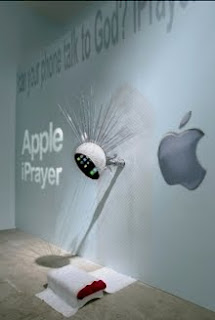
Apple©'s new iPhone4© dock, called the "iPrayer©", is designed around what Apple© is referring to as "...quite simply, the most advanced consumer level communication antenna ever created..." Although the device is said to severely limit mobility, Apple© feels that their antenna's ability to open a clear channel with the Almighty, combined with the new "hands-free" design, more than makes up for the minor mobility limitations.

"I could clearly hear the people who were similarly equipped with iPrayers©, even though they were in the next room!", said one test-user, "Oh ya, I spoke to God® too, but those people in the next room!! Wow, it was like they were right there in front of me!"

Which of course, they were (see photo below).

"Ya, I got God® on the line" stated another tester, "but I really bought the iPhone©  for music and gaming, so the God® feature is something I'll likely never use. Except maybe to have him hook me up occasionally."

Not everyone was so neutral about the new dock's special features. Many beta testers found they  received  repeated costly texts from The Creator®. "I sure didn't appreciate His tone",  said one incensed user, "He kept calling me sinner, and telling me to repent. He even told me to smash my phone, how lame is that? But I will say, I've never had better cellphone reception. OK, maybe not as good as my Blackberry©, but close."

When asked how this release will correct issues with the antenna when the iPhone4©  is used outdoors in a more typical mobile situation, Apple© responded that "We've given our users a way to ask God® Himself for assistance. We feel that we've addressed the issue in a very Apple© creative and practical way. "

"Trivial claims of periodic signal loss and/or repeated dropped carriers, always leave out one very important factor," continued Apple© founder Steve Jobs©, "the iPhone© is much more than a cellphone. People are being unreasonable when they complain about the phone functions being problematic. It's just one small part of what the device can do. Apple Customers© understand this."

Spokespersons did admit however, that there have been early reports of users being erroneously connected with Satan® instead of God®, resulting in some minor cases of soul-loss, but that in all of the cases, users had placed their head in the receptacle incorrectly. "Look, we can't be held responsible for our users using the device in a way that is counter to what our design team envisioned." said Jobs©.

While the iPrayer© will be sold initially for a hefty $27,000.99 (not including in-home installation or increased utility costs), local licensed service provider Rogers© Communications warns that the cost does not include roaming charges applied to heavenly calls, and that users should select one of the many perpetual-prayer plans available, for the best value if they plan on contacting Jehova® on a regular basis.. Details on the specifics of God®'s contract with Apple© and Rogers© are being kept strictly confidential.

The iPrayer© should hit the streets in Canada© by late November.


The Prayer Antenna was designed by Paul Davies
for the "Transmission II: Airborne Show" in 2005.
Images were shamelessly lifted from his website
and then photoshoped for my own evil purposes.


And then of course there's this....


Apple's latest gadget thrills the faithful!

W E D N E S D A Y,  J A N U A R Y  2 7,   2 0 1 0


Apple has launched its highly anticipated new product, to be known as the iBacus, to thrilled Apple faithful at an event in San Francisco on Wednesday, while fans of real computers looked on with bewildered stares.

"We want to kickoff 2010 by introducing a magical and revolutionary product today." Jobs said to the cheering throngs, "Since we don't have one, this'll have to do."

The device, which sports no USB, flash drive port, keyboard, screen, mouse or memory, will "revolutionize how people count." iBacus purchasers will have three models to choose from. A desktop model, called the iBoxus, a laptop version, known as the iBookus, as well as a handheld version - the iBic. Prices range from US$3000 for the desktop to $699 for the PDA (or $99 with a 20 year data replacement plan - which ensures that any lost marbles will be replaced for standard fees). Although critics commented negatively on the non-replaceable battery, Jobs states that the battery is not actually used, and so should only have to be replaced once every few months, once the standard Apple new-release bugs are ironed out within the first year.

Although memory on the device is not expandable, Jobs promises many accessories and apps will be available through the Apple App Store. One such example... iBacus users will find a convenient bookholder attaches to the right side of the tablet with a magnet (battery, $75, not included), which can support up to a 230 page paperback in a very comfortable reading position. "This is a direct attack on the Kindle" said an Amazon spokesperson, after being told what a paperback is.

When questioned on the wisdom of releasing a product which is so obviously based on very old design and concept, and which other computer manufacturers have had little success in marketing themselves, Jobs replied, "Did you notice the Apple Logo??? It lights up. I doubt if the HP version had an HP logo that lit up! It did? Well it wasn't an Apple product. Apple users buy what I tell them to.  This is the bleeding-edge of derivative tech!! You people just don't know how to think different." 

Which seems to mean not thinking at all!

Within seconds of this statement, the crowd began to chant "Apple Ohhhm, iBacus Ohmmm", perfoming self-flagellation and speaking in tongues.

In related news, Microsoft announced it's new multiple application productivity suite, which will be used to replace Office 2007. Microsoft must stop selling their current product by February because of a recent copyright infringement lawsuit. Called "Closed Office", MS CEO Steve Ballmer says  that, "This time, we made damned certain that we acquired any companies who's code we stole , before they could identify it. That'll save us millions, I tell ya!"

My resolution did not address my propensity for procrastination...

S U N D A Y,  J A N U A R Y  2 4,   2 0 1 0

It's a little late for New Year's platitudes, so let's just get to it...

I was going to make my first post of 2010 a "best of" this, "worst of" that...but seeing as it's taken so long for me to decide on the topic, I'm gonna cheat a bit, and at the same time offer something that is uncharacteristically less cynical at the top of the decade. Maybe it's 2012 looming on the horizon (remember how devastating Y2K was!!!) or maybe it's just that I desperately needed a break from  all of the earsplittinloudenboomer noise, of this very loud, and out of control 21st century.

Either way, I'd like to start this decade by taking you back twenty years - nearly to the day...

If you've played with some variation of home computer since their inception, as I have, then I can guarantee you'll be treated to some sweet nostalgia. If you're fairly new to computers, but really enjoy blogs, forums and peer-to-peer, then you'll be entertained by a little history lesson about the early days of your hobby!

In the fall of 1989 I was a member of The Metro Toronto ST User Group (MTST), an Atari enthusiast group. At least I assume I was, because when I moved a year ago, I uncovered the February 1990 issue of the MTST Newsletter in which, much to my memory-deficient surprise, I had written an article!

It's certainly is not the best thing I've written, but what the heck... I'm not posting it to put forward a 20 year old opinion - most, if not all, of my arguments are no longer valid in the context of technology today. And it is that very reality - the massive advances in technology in 20 short years - that gives this piece more entertainment value today than it had in 1990!

So here, direct from the age of BBSing (ask your parents), out of print for 20 years, is my very own:

CONFESSIONS OF A SOFTWARE PIRATE
(bet that'll get a few search hits!)

Confessions of a Software Pirate...

T H U R S D A Y,  F E B R U A R Y   0 1,   1 9 9 0

I sat in excited fascination as the modem began to make strange screeching noises. The cursor streamed to the top of the screen at a dizzying 300 baud and printed its one word announcement...

"CONNECT"
>

We had just made contact with a Bulletin Board System (BBS). I was still a little confused about exactly what that was, but my friend assured me that I was in for some pleasant surprises.

He sat at his Atari 800xl pressing a key here and there, bring to the screen a myriad of interesting menus, all done up with brilliant use of ASCII characters for graphics. One menu had the shape of a woman's face, another was in the shape of a telephone. I told him that I thought that was all great, but he replied that the best was yet to come.

He struck another key, and a list of programs began to scroll up the screen. "So you see," he explained, "when you get your computer, you don't have to worry about buying a bunch of stuff, just invest $200.00 on a used modem, and you can get all the software you'll ever need absolutely free!"

This was my first exposure to the wonderful(?) world of software piracy and I've got to be honest, I was impressed. Here at my fingertips were all the games and utilities I was ever going to need, and it was going to cost me a one-time purchase of a little blue box with flashing lights. Not only did the directory being displayed list out golden oldies, but also programs that I knew had just hit the markets. (I would later learn that you could even find programs that were not as yet in stores!) I was sold. A week later I was unpacking my new system, complete with my "personal software supply house" - a modem.

It would be four years, and hundreds of program-packed 5 1/4" floppy discs later, before I would take a long, hard look at exactly what it was I was doing. I was about to become a software collector. It didn't really matter what I collected, as long as I had the latest "Hot Releases." And heaven forbid that someone else had a title that I had not as yet acquired.

Calling BBS's all the time started to become a little tedious, so I decided to put up my own board and let other people call me with software, I was already well versed in the inner workings of "elite" memberships, and knew that discretion was imperative. In other words, I was very much aware that I was breaking the law, but justified my actions by telling myself that it was a victimless crime. These software companies were, after all, huge firms making a fortune selling their goods at inflated prices. I was also helping out new computer users, by inviting them over to fill up those blank discs of theirs. I hadn't been so popular since Sandra Martin agreed to be my date for the graduation dance.

The BBS phone line was ringing constantly. Every night I would return home from work and have new files to validate. Some were garbage, but then again, a program's quality didn't matter as long as you filled your discs and had a lot of them full.

A few points can be taken from the above revelations. First, my past is hardly as pure as the driven snow when it comes to copyright infringement, and I do understand the attraction. Second, software piracy is rampant. There is virtually no commercial software that is not readily available on hundreds of boards throughout the city, regardless of system configuration, operating system, or wants/needs. Lastly, it's not just a case of getting a particular program to test, it's more an obsession with possessing everything that is available!

It may seem hypocritical that a self-confessed ex-pirate would decide to chat with you on the evils of piracy, and you are probably curious as to what caused my sudden change of heart. I did have one pastime that most stolen software collectors did not share - I also invested heavily in the purchase of original packages. I was getting to know more and more computer users who had never bought a single piece of software, and this offended me. Not so much that they never supported the industry in which they were hobbyists, but more that they exuded an arrogant pride in the fact.

This arrogance, coupled with the fact that more and more developers were looking at (and dropping) Atari Computers as a "high risk" system to write for, made me decide that enough was enough. I started to become more vocal than a reformed smoker in a smoke filled cafeteria! (2010 note: yes people smoked in cafeterias in 1990) I joined forces with Tony Elliott of the Grand Hotel BBS, and set out to prove that a privately operated "public domain only" board could be as popular (if not more so) as any pirate board around. What I discovered though, came as a surprise...the more adamantly anti-pirate my message became, the more we received mail accusing us of having "hidden" file areas. It never ceased to amaze me that even during a two-month period where our message bases were dominated by conversations on piracy and why we opposed it, we still received requests from users for access to our non-existent "private" areas. Either no one was listening or we had hit a ploy used by the very boards we were talking about. As it turns out the latter was the case. I found on my own online travels that the systems that were the most vocally opposed to piracy were quite often the ones with the largest amount of storage space dedicated to the genre (2010 note: we're talking as much as 2 or 3 megabytes of storage!!)

There is a whole list of arguments from the pro-piracy camp, while sadly, the few counterpoints tend to sound redundant. That is simply because talking to a confirmed pirate about the harm being done, is like explaining the theory of relativity to a five year old, and so one tends to repeat the same points over and over. I'll attempt to address some of the more common defenses that have arisen in my message bases on the topic...

"Many programs for sale are garbage, and not worth the price."


Does this mean that you only copy bad software and actually buy the packages that are worth the price? It is more likely that you are punishing the entire industry for a couple of bad purchase decisions on your part. There are several periodicals supplying fair reviews of products to help guide your decisions. You would also find user's groups and reputable Bulletin Board Services to be an invaluable source of information on the true value of new releases. It is certainly not difficult to write a message asking if anyone has tried a given program. A couple of days and you'll have opinions from all over the place! If you decide to blindly purchase software based on dazzling packaging then it's Caveat Emptor - buyer beware! A related argument is...

"I like to try a program before I buy it."


Of all the excuses for pirating, this is the most convincing, as well as the most difficult to counter. I do have to ask one question though; how often have you actually bought a product that you were happy with, after having "tested" it via a downloaded copy? In the case of application software, many users eventually part with their money for the sake of acquiring documentation, and not because they felt that the author(s) deserved support. Instead of using a pirated copy to test with, why not borrow an original from a friend (if you actually have a friend who owns an original copy of anything). Or how about writing a letter to the distributor asking for a demo version. More and more software houses are making "save-disabled" demos available. All it takes is a short note to them or a call to an information service such as Genie, Compuserve or CRS. Finally, you could simply ask if you might try the package out in the store. Although I am always told that retailers won't allow it, aside from testing games, I have NEVER been refused! Simply make it clear that you DO intend to buy if the product meets your needs... (2010 note: Not only could you test-drive any non-game software you wanted in the store, you could ask for an ashtray and have a cigarette while doing it!) 

"Software prices are too high. I can't afford to buy it."

Software is to computers what gasoline is to cars...it makes them go! Gasoline is becoming exceedingly expensive (2010 note: ya right! just wait!) yet few motorists steal their fuel! Indeed, when purchasing a car, operating costs are very carefully considered. Why should the same not be true of computers? Before buying a computer, take into consideration that, like all hobbies, it can become fairly expensive. A few years ago, when I was earning a whopping $10,000 a year, Atari released Pac Man for the 2600 VCS. The cartridge cost over $100! Certainly the quality of today's games outweighs that of the original 2600 cartridges, yet the average price for a video game is now floating in the $50 range. This would indicate a drastic price reduction, and not an escalation!
To further counter the argument, I should add that earlier this week, someone uploaded "Deluxe Asteroids" to The Grand Hotel BBS. This game is available in "bargain bins" throughout the city for the outrageous price of $9.99. Surely this isn't expensive for a piece of quality game software! Why then is it being distributed as a pirate file?? Maybe it's because...

"MS DOS users pirate more than we do. Atarians are just being picked on!"

Well, I am certainly not going to deny that software theft is a problem on every make and model of micro, and yes, I know that the distribution of pirated files is more serious in the PC world, but overall size of the market has got to be considered. Let's say, for arguments sake, that only 40% of Atari users make use of pirated software, while the same holds true for 65% of MS-DOS users. The remaining 35% of PC users is a far, far greater number of consumers than the remaining Atarians. We all know that Atari computers are not popular in North America. Whatever the reason, we have a small user base here, and we're a drop in the bucket of all computer users. If nearly half the software developed is stolen, what motivation is there to support us with ports of exiting products, or the creation of new ones? Atari users are also considered to be the most advanced users around. Although this may seem like a compliment, in the eyes of authors and distributors, this just means that code will be cracked much more quickly and efficiently than on other systems.

"Taping records and movies is against the law too, why are computer users being hit on for doing the same thing as everyone else is doing?"

Copying a movie or a record has far less serious repercussions to the individual industries than the copying of software. When you copy a movie from TV, that movie has been paid for by the network, and the fact that it is on television means that it has already run it's course through theatrical and videotape releases. When you tape an album, you obviously knew someone who had bought the record that you borrowed to tape, In both of these cases, your copy is being made after the distributors have already made their money.

With the mass distribution abilities of online systems, thousands of users can acquire a piece of software from a single original. You will also not suffer the loss of quality inherent in third or fourth generation audio or video recordings. There are no video BBSes offering downloads of first generation copies of films, and no dial-a-record services, allowing you to hook your cassette deck up to your phone! In all forms of piracy besides software, the user is never far removed from the profit makers, and as the user distances himself, the quality diminishes. Do you know where that 'blast-em-till-you-drop' video game you just downloaded came from? How many BBSes have the same file listed. How many that don't are you going to upload it to? How many nodes?

As you can see, when you stop to think about it, that's the major difference between software piracy and all other forms of illegal copying...potential distribution!